
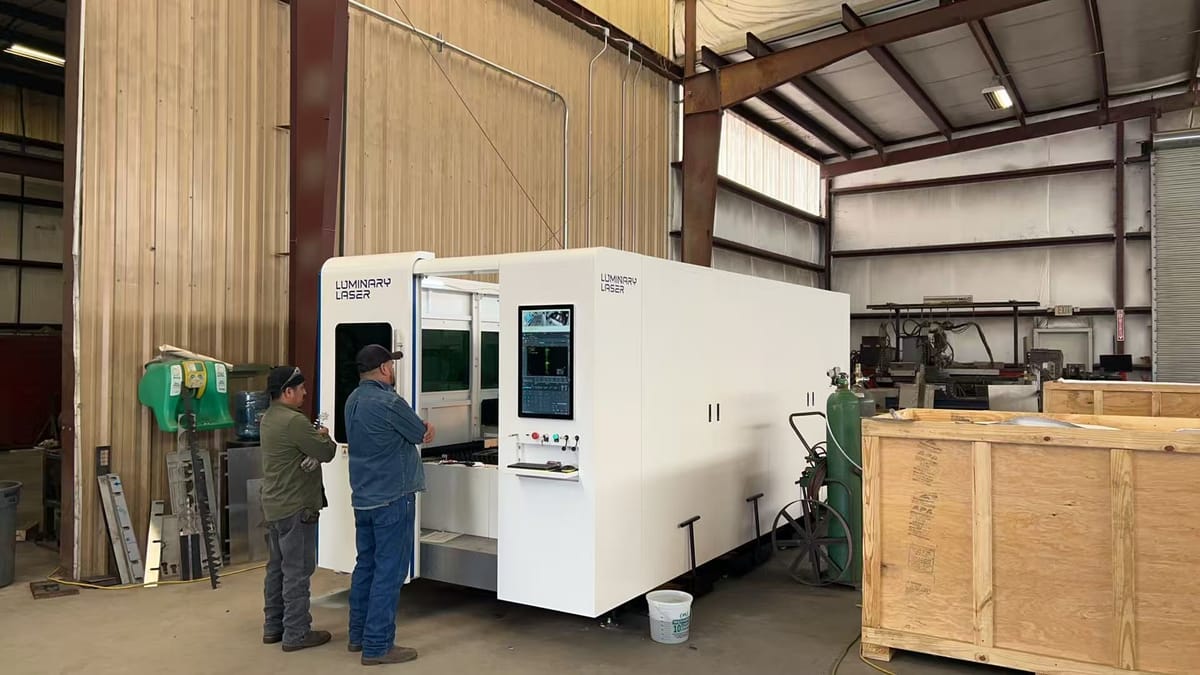
Why automation is a timely laser-cutting topic
EuroBLECH is scheduled for October 20–23, 2026, in Hanover. This article is a pre-show purchasing guide, written on October 16; it is not a report of demonstrations already attended. The topic was selected from current manufacturer announcements, not a claim that it has the highest measured search volume.
TRUMPF’s official preview describes AI-supported sorting, camera-based process visibility, and connected material flow. EAGLE’s preview pairs higher-power cutting developments with automation of separation, handling, and sorting after cutting. Together, these announcements make the complete production route a useful topic for buyers to examine. These are supplier announcements, not independent performance results or features promised for LUMINARY machines.
Turn an automation claim into a purchasing question
Use this worksheet to define the scope of a supplier demonstration. It is not a specification for a particular product.
| Claim | Question to ask | Evidence to request |
|---|---|---|
| AI-assisted cutting | Which decisions does it suggest or control? | Supported conditions, operator approval, and exception log |
| Automatic loading | What stock preparation and operator work remain? | Trial with your stock format and changeovers |
| Automatic sorting | Which parts need manual separation or handling? | Mixed-part trial with identification and rejected picks recorded |
| Unattended production | What happens when the process needs intervention? | Agreed operating limits, recovery procedure, and acceptance trial |
| Higher laser power | Does it increase accepted output for our part mix? | Whole-route comparison, including handling and downstream capacity |
Separate AI assistance from physical automation
Ask what the proposed feature actually does. A system that recommends process settings is different from one that monitors a cut, loads a sheet, separates parts from a skeleton, or delivers sorted components to the next operation. List the input, output, operator action, and exception procedure for each quoted function.
For an AI feature, ask which materials and conditions it supports, who approves parameter changes, and how an operator identifies an incorrect recommendation. Establish whether it needs an internet connection, a subscription, uploaded drawings, or access to production data. Put offline behavior and data ownership in the supplier discussion before comparing prices.
Measure the bottleneck before buying more laser power
Record a representative production shift: job preparation, stock availability, loading, cutting, unloading, sorting, inspection, and waiting for downstream work. Identify where accepted parts accumulate. The station with the longest queue deserves investigation, but check whether poor scheduling or repeated quality problems created that queue.
For illustration only, consider a sequential job with 10 minutes of cutting and 20 minutes of handling and sorting. Halving cutting time changes the total from 30 to 25 minutes, a reduction of about 17%, not 50%. Real machines may overlap operations, so calculate the result from your actual production sequence. This example is not a throughput promise for any machine.
Run the demonstration with difficult parts as well as easy ones
Provide a small, representative set of drawings with your usual materials and thicknesses. Include the part that causes sorting confusion, the frequent changeover, and the job that needs extra inspection. Agree on acceptable edges, dimensions, part identification, and handling marks before the trial starts.
Measure accepted parts delivered to the next operation over the agreed trial, including operator interventions and recovery time. Request a record of loading, cutting, separation, sorting, and rejected parts. Ask the supplier to demonstrate a controlled recovery from a routine exception within its approved operating procedure. Do not infer unattended-production capability from a short successful cutting video.
Compare the complete cost and the work still left to operators
Request separate quotation lines for the cutting machine, loading equipment, storage, sorting, software, integration, installation, training, and support. Ask which items are optional and which are required for the demonstrated workflow. Check the subscription period and how changes to the part mix affect programming or tooling.
Build the investment estimate from your measured baseline. Use realistic productive hours, labor that can actually be reassigned, accepted-part output, consumables, and maintenance. Include the cost of clearing exceptions and restarting production. A machine can cut faster without producing more saleable work if another operation remains constrained.
Choose a staged configuration when the application is uncertain
A staged investment can be useful when product mix or demand is still changing. Ask what can be added later, which interfaces are included now, and whether future integration would require moving the machine or replacing software. Obtain those commitments in the written scope; a general claim that a machine is automation-ready does not define an upgrade.
LUMINARY LASER can discuss its listed sheet and tube equipment with buyers through its Houston team. Send your material, thickness range, drawings, shift volume, current bottleneck, and installation location for a configuration review. AI monitoring, robotic sorting, and unattended operation must be confirmed for the specific quoted system; the industry examples above do not establish those capabilities for our catalog.
Technical references
Technical sources and scope.
Supplier-specific performance claims are not treated as universal. Confirm the selected process with controlled sample cutting and the final equipment documentation.
FAQs
Frequently asked questions.
Is an AI laser cutting machine automatically an unattended system?
No. Identify the actual AI function and separately confirm loading, unloading, exception handling, supervision, and the approved operating conditions. A monitoring or recommendation feature alone does not establish unattended operation.
Should a small fabrication shop buy automation or more laser power first?
Measure the current bottleneck and compare sample results for the proposed changes. If handling or sorting dominates the workflow, a faster cutting cycle alone may have limited effect. The right investment depends on the shop’s part mix and complete production route.
What should a laser automation demonstration include?
Use representative drawings, stock, and changeovers. Agree on quality requirements and record accepted parts, operator interventions, handling, sorting, and recovery time over a defined trial.
Does LUMINARY offer every AI feature described in this article?
No such claim is made. The article discusses current industry announcements and purchasing questions. Confirm all hardware, software, integration, and automation capabilities in the specific LUMINARY quotation.
Join the conversation
Reader discussion
Share a question or your experience with this topic. Comments appear immediately after submission. For a machine quotation, contact our team directly.
Loading reader comments…
Leave a comment