
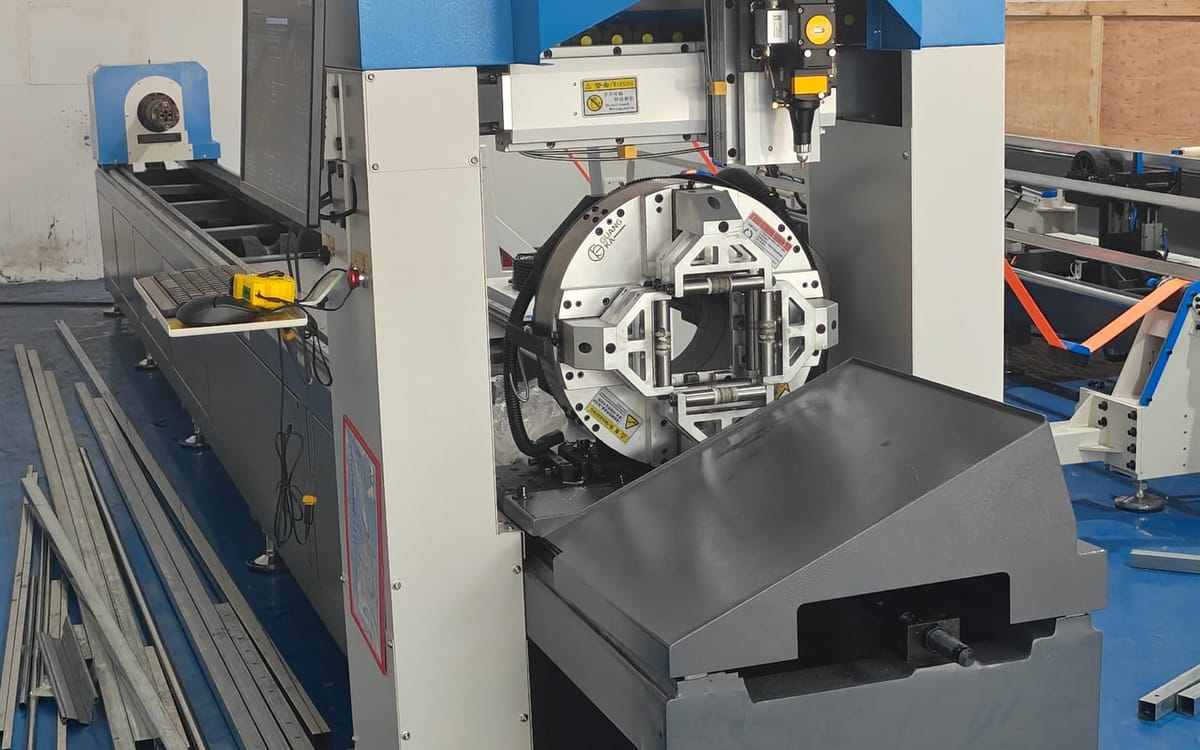
Plan round tube range, wall thickness, and part features
Round tube, square tube, rectangular tube, and shaped tube all place different demands on clamping, support, and cutting path control. Before selecting a model, define the tube profiles used most often and the maximum length you need to process.
If the shop processes complex tube geometry, follower support and stable feeding become important for accuracy and repeatability.
Choose loading based on production volume
Semi-automatic tube laser cutters can be a practical fit for mixed production and lower volume work. Fully automatic loading systems help reduce handling time when repeat jobs and higher throughput are priorities.
The best choice depends on daily production volume, labor plan, part nesting, and how often operators switch between tube sizes.
Consider beveling and secondary operations
Beveling tube laser machines can reduce downstream preparation for welded assemblies. If your products require angled cuts or weld-ready edges, beveling capability should be part of the initial quote conversation.
For many shops, the value of a tube laser comes from reducing manual layout, drilling, saw cutting, grinding, and fixture preparation.
FAQs
Frequently asked questions.
What should be reviewed for round tube laser cutting?
Review the outside diameter, wall thickness, typical tube length, required holes or copes, cut quality expectations, loading method, material flow, and downstream welding or assembly needs before selecting a configuration.
Can one tube laser handle round and square tube?
Many tube laser configurations can be planned for more than one supported profile type, but the practical range depends on the selected chuck, loading system, profile dimensions, wall thickness, and required features. Confirm the final range during machine selection.
When should bevel cutting be included for round tube parts?
Bevel cutting is worth reviewing when tube joints need consistent weld-preparation geometry or when manual coping and beveling create extra handling. The required bevel angles, joint design, wall thickness, and downstream welding procedure should be confirmed first.
Join the conversation
Reader discussion
Share a question or your experience with this topic. Comments appear immediately after submission. For a machine quotation, contact our team directly.
Loading reader comments…
Leave a comment